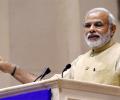
Union Minister Pankaj Chaudhary stated that Prime Minister Narendra Modi strengthened the Enforcement Directorate (ED) to combat financial crimes like money laundering and corruption, dismissing allegations of it being used to target political opponents.

The Income Tax Department has clarified that income from the transfer of investments made before April 1, 2017, is excluded from the scope of the General Anti-Avoidance Rules (GAAR), addressing industry concerns about retrospective application.

Analysts predict that the ongoing conflict in West Asia, crude oil price fluctuations, and the US Federal Reserve's interest rate decision will significantly influence the Indian equity market this week.

Indian equity markets experienced a significant downturn, with the Sensex and Nifty plummeting due to rising crude oil prices, geopolitical tensions in West Asia, and continuous foreign fund outflows.

Indian stock market benchmarks Sensex and Nifty rebounded strongly after a two-day decline, driven by falling crude oil prices and positive global cues amid hopes of de-escalation in the Middle East.
Union Minister Pankaj Chaudhary stated that Prime Minister Narendra Modi strengthened the Enforcement Directorate to combat financial crimes like money laundering and corruption, dismissing allegations of it being used to target political opponents.

There is record underperformance and under-ownership. Some of this is cyclical and will turn on its own. However, we also need to regain our growth credentials. For this, both the government and companies have a role to play, as do investors, points out Akash Prakash.

Foreign investors pulled out Rs 21,000 crore (around $2.3 billion) from Indian equities over the last four trading sessions amid deteriorating global risk sentiment triggered by the West Asia crisis.

The Indian rupee rebounded against the US dollar after the Reserve Bank of India (RBI) restricted banks' net open positions in dollars. This move prompted banks to sell dollars, providing temporary support for the rupee amidst ongoing geopolitical tensions and rising oil prices.

'The next phase of India's IPO cycle will be defined by quality, pricing discipline and investor selectivity.'

India's defence sector is on the cusp of a 'super cycle' of growth, driven by escalating geopolitical conflicts and a strong policy push towards indigenous manufacturing, with major players like BEL, HAL, and BDL poised for significant order inflows and technological advancements.

Fixed deposits from nationalised banks delivered higher returns than equities, outperforming both inflation and stock market benchmarks.

Indian stock market indices Sensex and Nifty closed nearly 1 per cent higher, marking their third consecutive day of gains, supported by a slight decrease in crude oil prices and positive global market trends.

The Central Bureau of Investigation (CBI) has arrested Ayush Varshney, co-founder of Darwin Labs, in connection with the 200 million Gain Bitcoin cryptocurrency scam. Varshney was apprehended while attempting to flee the country.
Foreign portfolio investors (FPIs) withdrew a substantial amount from Indian equities in the first half of March, driven by geopolitical tensions, rupee depreciation, and concerns about crude oil prices.

The Indian rupee depreciated by 32 paise to close at 92.83 against the US dollar, influenced by escalating global tensions, particularly the US-Iran conflict, and the deadline for the RBI's instructions to banks to curb overnight positions.

'We want to become India's topmost integrated studio, working in different languages.'

Dabur India's stock has fallen over 17 per cent since the start of the Iran war, driven by concerns over a weak monsoon, the West Asian crisis, and rising input costs, which are expected to impact the company's revenues and margins, particularly affecting its significant rural sales and international markets.

Rajasthan Royals is set to be sold to US-based Kal Somani-led consortium for US$ 1.63 billion (approximately Rs 15,290 crore), becoming the most valuable IPL franchise.

The Indian rupee weakened to a record intra-day low against the US dollar due to a strengthening greenback, continuous foreign capital outflows, and elevated global crude oil prices amidst the West Asia conflict.

Indian stock market indices Sensex and Nifty experienced a significant decline, driven by rising crude oil prices, sustained foreign fund outflows, and selling pressure in major bank stocks.

Infosys shares experienced a significant drop, hitting a 52-week low, after the company announced its Q4FY26 results and provided a modest revenue growth guidance of 1.5-3.5 per cent in constant currency for FY27, falling below market expectations and raising concerns about AI-led deflation and margin pressures.

Affordable homes, priced under Rs 40 lakh per unit, may not be attractive anymore, not just for developers but also for investors, with the segment seeing a 26 per cent price rise over three years since 2022 versus 40 per cent returns from luxury homes priced Rs 1.5 crore and above.
Indian stock market benchmark indices Sensex and Nifty experienced a significant decline, driven by escalating tensions in the Middle East and rising crude oil prices.

Rising stressed debt and past exposures like Reliance Capital, Yes Bank push EPFO to frame exit rules for its portfolio.

Indian equities on Dalal Street saw volatility. Track Sensex, Nifty50 movement and key market drivers for Feb 25, 2026.

The Indian trading and investment space has transformed exponentially in the last few years, and technology plays a pivotal part in how traders engage with the markets. In 2026, brokers are far more than order-execution platforms; they provide several value-added features to market participants to facilitate a data-driven and seamless trading experience.

The Indian rupee gained 2 paise to settle at 93.33 against the US dollar, driven by positive sentiment in domestic equity markets and renewed hopes for US-Iran talks, despite rising WPI and CPI inflation.

Is Bhutan merely experimenting with digital finance -- or is the Himalayan kingdom punching far above its weight, quietly playing one of the most sophisticated strategic games in Asia today? asks Varun Arya.

Indian equity markets experienced a volatile trading day, with the Sensex and Nifty closing almost flat. Market sentiment was influenced by global cues, US-Iran talks, and profit-booking activities.
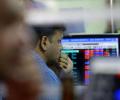
Indian stock market benchmark indices Sensex and Nifty experienced a significant drop in early trade due to rising crude oil prices, bearish global market trends, and continuous foreign fund outflows.

Households should moderate large discretionary expenses for the time being.
'They should prioritise essential spending. They should maintain an emergency fund covering 6 to 12 months of expenses.'

A new report, 'India's Sports Startup Ecosystem: Current Status and Emerging Pathways,' was unveiled, offering insights into the sports industry's growth potential, innovation, and opportunities for stakeholders as India prepares to host major international sporting events.

Indian equities on Dalal Street saw volatility as global market trends and fresh tariff concerns linked to Donald Trump impacted investor sentiment. Track Sensex, Nifty50 movement and key market drivers for Feb 24, 2026.

The inauguration of Noida International Airport (NIA) is set to significantly increase property values in micro-markets along the Yamuna Expressway, with projections indicating a 28 per cent rise for plots and 22 per cent for apartments over the next two years, according to Colliers.
Speaking at a seminar in Kochi on 'Opportunities in Africa', ambassador of Rwanda to India Lt General Kayumba Nyamwasa said unfair portrayal of African nations in the international media kept investors away from the region. India was in a happy situation in the field of technology, affordable education and knowledge transfer. Africa was also on the move and had come to peace with itself, he said.

Indian benchmark stock indices Sensex and Nifty rebounded, closing over 1% higher, mirroring a global equities recovery after recent losses due to geopolitical tensions.
Soaring inflation and market volatility notwithstanding, Indian investors have emerged most optimistic in Asia and many of them believe the economy has improved in the second quarter of 2008, says a survey.
Benchmark indices Sensex and Nifty experienced a significant decline, falling over 1 per cent due to foreign fund outflows and global uncertainties.

BCCI vice-president Rajeev Shukla said the BCCI cannot intervene as the signing is related to a foreign league and it is up to the franchise to take a call.
